12/13/13: On the final day of
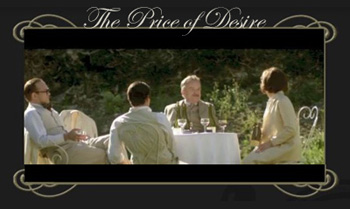
the shoot, the production staged a reenactment of the February 2009
record-breaking $28m Paris sale at Christie’s of Gray’s Dragon Chair. The
reenactment will be the opening scene and recreates what remains the highest
price paid for an item of 20th century design. Cheska Vallois of Galerie
Vallois, who bid for the anonymous private client who bought the chair,
plays herself in the production and famously explained the high price-tag to
reporters immediately after the auction by saying "it can only be the price
of desire."

Reviews:
Leslie Felperin, The
Guardian:
"Biopic of architect Eileen Gray fails to build interest.
This docudrama taking on her life, loves and career
highlights is sometimes borderline risible, but even so, one can’t
but fail to be impressed it got made at all, given the subject is
really mostly of interest to design geeks and those fascinated by
intellectual property law... Somehow the tacky
piano score amplifies the ineptitude of Mary McGuckian’s direction."
Donald Clarke, The Irish
Times:
"The film certainly has things to say to the uninitiated,
but, sadly, it chooses to say them via hunks of indigestible
dialogue that play to the rhythms of the online encyclopaedia... Too many Cote d’Azure exteriors are shot in weird soft focus that
suggests comic dream sequences from Absolutely Fabulous. The
film-makers are so delighted with Brian Byrne’s lovely music that
they shovel it over virtually every scene, thus suggesting a
condition of permanent emotional climax."
Stephen Dalton, The
Hollywood Reporter:
"A noble aspiration, but sadly this house is built of very
flimsy materials. Beyond students of architecture and feminist
cultural theory, audience appeal will be slim...
McGuckian and her cinematographer Stefan Von Bjorn clothe the story
in a bleached-out pastel palette suffused with Mediterranean
sunshine, rendering every tableaux as artfully hazy as a high-end
shampoo commercial... Brian Byne's syrupy,
piano-saturated score is no help, wafting intrusively across every
scene like cheap perfume... The Price
of Desire features a capable core cast, but they are all stuck
in one-note mode... Gray's important story is
worth telling, but with more passion and insight than this starchy
biopic can muster."
Paul Whitington,
Independent:
"Mary McGuckian's The Price of Desire takes a wonderful
story and makes a bit of a hash of it. Orla Brady is Eileen Gray,
the Wexford-born designer and architect who became a leading figure
in the Modernist movement in Paris in the 1930s and 40s. In Ms
McGuckian's film, we find out how Le Corbusier and others passed off
her work as their own, but The Price of Desire is stilted and
clumsy and unimaginative in the extreme."
Entertainment, ie:
"The dialogue veers from sounding like two lecturers debating in an
empty hall or culled straight from memoirs and yet, bar those
students of the form, are never privy to the wider context: what
made Gray’s stand out? The characters, cold and aloof, are a bore
and don’t entice engagement with their various predicaments; villain
of the piece Le Corbusier is the only one with any real life but in
regularly breaking the fourth wall - a biased opinion on the scene
unfolding - snaps the audience out of the moment. McGuckian’s
framing is sometimes stiff as if one is watching actors mill about
an art exhibition, the velvet rope just out of shot. The lifeless
pace isn’t helped by the syrupy soundtrack which drips over every
line of dialogue, which itself sounds dubbed. The biggest fault
though it’s that The Price of Desire doesn’t sell E-1027 as
something beautiful or how ground-breaking the design was.
Rose McDermott,
Hotpress.com:
"Risks are taken with the film’s design, as the theatrically staged
and tightly choreographed conversations – complete with fourth
wall-breaking monologues – echo the chilly elegance of the modernist
sets. The problem is that the aesthetic and the interactions quickly
feel stilted and claustrophobic. Cinematographer Stefan Von Bjorn’s
camera lens seems permanently coated in Vaseline, perhaps a nod to
Gray’s love of lacquer. However the effect comes across not as
modern and assured, but as hazy and old-fashioned."
Joyce Glasser, Mature
Times:
"Irish filmmaker Mary McGuckian’s attempt to restore Eileen Gray’s
reputation is nothing if not earnest. It is perhaps her reverence
and desire to get the facts straight that has hampered the
dramatization. The result is an expository and surprisingly dull
film that adds little to the documentary, Gray Matters.
Clive Botting,
Huffington Post:
"The story of the egotistical Le Corbusier (Vincent Perez), 'The
Father of Modernism,' determined to erase the Irish bisexual
modernist designer Eileen Gray from the memory and her relationship
with her lover Jean Badovici (Francesco Scianna), the editor of the
influential L'Architecture Vivante is the stuff of rivalry and
inflated egos. Unfortunately, Mary McGuckian's low budget period
biopic is a limp along, lack lustre portrait with a stilted script
and at times is more akin to a shoot for a fashion mag."
Spoool.ie:
"Unfortunately the film about one of the most important figures in
the Modernist Movement in architecture – directed by a woman and having a
female actor in the lead role – has come out as a melodramatic love story
devoid of any real emotion... The costumes, look of the film and acting are all well
worth enjoying. It is the material they have been presented with and
ultimately how it has been sewn together and presented to us that is the
film’s downfall. The blame for this rest solely at Mary McGuckian’s feet."
Filmuforia:
"Writer/director Mary McGuckian has done the avant-gardist
designer and architect Eileen Gray (1878-1976), no favours as the
main focus of her feature bio-pic The Price of Desire: a
turgidly slow and Kitsch affair, it also manages to be a pretentious
melodrama of the worst kind, colliding frontally with Gray’s cool
artistic output and her self determined personal life... The scenes
shot by DoP Stefan von Bjorn in the renovated Villa E 1o27 are the
highlight – at least we see, in detail, Gray’s – then revolutionary
– approach, to make the border between furniture and architecture
indistinct. The rest are of the images are on a par with the
narrative: grandstanding, pompous and utterly unimaginative. Just
the opposite of what Eileen Gray stood for."